

Stop Exhausting Yourself Trying to Save People
Unlearning The Hero Complex and Finding Gratitude Instead of Burnout

I spent years showing up for people and leaving those interactions feeling depleted. My intentions were good, but I misunderstood what I was doing. I thought I was meeting their needs, but I was using their struggles to manage my own insecurity. What I called helping was actually conditioning from past trauma.
And yet I could not stop, because at that moment it felt like love.
So, did this hero complex come from childhood? Is it possible that I was conditioned into this pattern?
Dr. Rachel Naomi Remen, a physician and author who has spent decades studying the relationship between helping and healing, draws a distinction that cracked something open for me. She observes that while helping sees life as weak and fixing sees it as broken, serving sees life as whole.
Helping, she suggests, often comes from seeing others as needing more than they do, which risks taking away their strength. Serving, by contrast, is an equal and authentic connection. I borrowed her framework here because I could not find a better one, and I kept returning to it as I tried to understand why my own helping so often left both of us worse off.
This shift is about the lens you are looking through. Let me break it down:
1. When you help, you see life as weak
Helping often comes from a place of “I have something you lack.” There is an unspoken hierarchy. You are strong, they are weak. You are whole, they are not. It is compassionate, but it still creates distance.
Example: You bring soup to a neighbor who is sick. Kind? Absolutely. But the dynamic moves from giver to receiver. If you only ever help, you might start seeing people primarily through their deficits.
2. When you fix, you see life as broken
Fixing assumes something is wrong that needs your intervention to be right again. You become the expert, the mechanic. The other person becomes a problem to solve. It is well-intentioned, but it can rob them of dignity and agency.
Example: Your friend is grieving and you jump into “you should try therapy, get out more, start dating again.” You are treating grief like a malfunction instead of an experience. You see brokenness, so you try to patch it.
3. When you serve, you see life as whole
Serving starts with the premise that wholeness is already there. You are not above or ahead, you are alongside. You are not filling a gap; you are honoring what is present. Service asks, “How can I sit with you in this?” instead of “How can I change this for you?”
Example: You bring tea to the same grieving friend and do not rush to make the pain go away. You sit and listen. You trust that their process, even messy, is part of their wholeness. You are not there to rescue, you are there to witness.
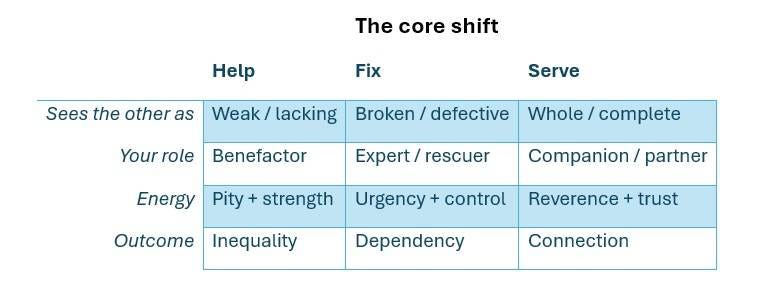
Fixing and helping may solve the issue, but service heals. That is Remen’s insight, and I have tested it enough now to believe her.
When I help, I feel satisfaction, a fleeting reward that meets my need for mattering. When I serve, I feel gratitude because I am meeting something deeper. It is the need to be genuinely useful to another person, on their terms.
Fixing is a form of judgment. It scans for what is wrong and assumes something must be corrected. Serving means showing up and paying attention. It asks what someone needs and honors their capability.
Fixing and helping are the work of the ego, which needs to be the hero in order to feel certain and in control. Serving is what happens when you set the ego aside and remember that the other person was never yours to save.
Types of Conditioning
Conditioning is an invisible script running in the background that tells you which role to play, before you even realize you are in the scene.
Cultural conditioning
Good people help. A lot of us grew up hearing that worth equals usefulness. Churches, schools, social media, and even movies all reward the hero who saves the day. So, we learn we only matter when we jump in to save the day. That is how the giver-to-receiver dynamic gets installed early. You start scanning for weakness because that is where you get your gold stars.
Family conditioning
Families assign roles without posting them. Maybe you were the responsible one, the peacemaker, the problem solver, the caretaker, or the overachiever. If you got love for fixing your sibling’s meltdowns, you learned that brokenness plus your action equals safety or love. If you were only praised when you were self-sufficient, you might flip it and never let anyone help you. It is the same conditioning, just a different side.
Trauma conditioning
If chaos or loss taught you that things fall apart when you are passive, fixing becomes a survival strategy. Your body learns that if you do not fix it, it gets worse. So, you walk into every room scanning for what is broken. You are not judging, your nervous system is trying to keep you safe.
Productivity conditioning
We are trained to value output and efficiency. Serving looks inefficient because you just sit there and listen. Helping and fixing get results you can measure. The problem gets solved. The person gets fed. The crisis gets averted. The system rewards the giver and the fixer, so we default to those modes. Presence does not fit on a performance review.
Here is how conditioning plays out in the help-fix-serve dynamic:
“I’m only lovable if I’m useful.”
When this belief is running, you automatically see weakness in others. Flaws and needs jump out first. Your default mode becomes Help, which sets up a giver-and-receiver dynamic. You step in to be useful, and they become someone who needs you.
“If I don’t control it, it collapses.”
With this belief, brokenness is everywhere. People seem overwhelmed, and problems feel urgent. Your default becomes Fix. You become the one who holds it together, and the situation becomes something to solve.
“My worth isn’t tied to doing.”
From this place, you see wholeness even in mess. People are not projects. Situations are not failures waiting to happen. So instead of helping or fixing, you default to Serve. There is no hierarchy. Just presence.
Conditioning is not a moral failure. It is repetition. Your brain took shortcuts to keep you safe in the environments you grew up in.
The Kindness I Had to Learn
For years, I thought kindness meant making things easier for people. If they were hurting, I would soften it. If they were stuck, I would lift them out. If they were confused, I would hand them my map.
But that version of kindness was about meeting my own needs for reassurance and mattering. It looked like care, yet it often bypassed what they needed which was the room to find their own way.
Real kindness, I am learning, is harder. It means I tell the truth without cushioning it. It means I let someone struggle while I stay close. It means I refuse to take away a lesson that belongs to them, even when my heart aches to intervene.
Kindness in service sounds like:
“I trust you to find your way. Do you want my company while you do?”
“I won’t fix this for you, because I respect your capacity.”
“Your pain isn’t mine to solve.”
That kind of kindness keeps us both equal. It does not always get me gold stars. But it costs me a lot less, and it gives them a lot more.

The Practice and How Long It Takes
Unlearning the helper or fixer takes years because the pattern lives in your body, not just your head. Your nervous system still equates urgency with love. Your worth still pings when someone says, “you saved me.”
I had to start asking myself what need I was meeting when I rushed in to help without being asked. The answer, almost every time, was that I was meeting my need for contribution and meaning, while overlooking the other person’s need for choice. That is why I felt resentment when appreciation did not follow. I had given something that was not asked for and then expected to be thanked for it.
Now I try to pause before I act. I check whether my support is truly wanted. Asking “Would you like my help, or would you prefer I just listen?” honors both their autonomy and my authenticity.
I remind myself that their struggle is not my emergency. I can offer presence without taking responsibility for the outcome.
I still slip. The pull to rescue is muscle memory. Some days I catch it before the advice comes out. Other days I only see it in hindsight, in the hollow feeling after I have overstepped.
Breaking conditioning is slow because you are re-teaching your body that safety does not require control. That you are still loved even when you are not helping. That kindness does not require making yourself smaller or someone else larger.
An Invitation
If you recognize yourself in the exhaustion that comes after helping, or in the sting you feel when gratitude is missing, you were simply trying to meet the need for purpose, safety, control, or belonging. That is not a character flaw. It is just misdirected care.
And if you are starting to practice a different kind of kindness, one that trusts instead of rescues, be patient with yourself. You are unwinding decades. You will backslide. You will feel useless in the quiet moments where you used to jump in. That uselessness is space, and it is where something truer gets to grow.
With Aloha,
Maria
“Their struggle is not my emergency.” That line landed. Many of us who genuinely care can end up carrying things that were never ours to carry. Not because we’re controlling, but because helping feels familiar and purposeful. Learning to stay present without taking over was one of the hardest lessons of all for me. Thanks for writing such a powerful essay. Ax
Serving vs. fixing is profound wisdom.